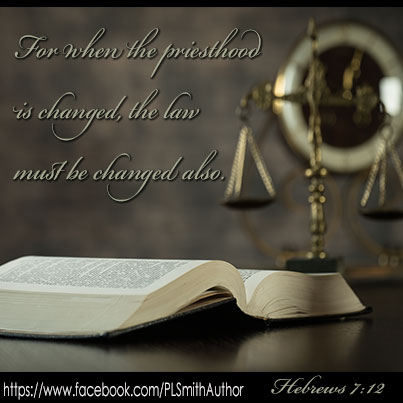
Hebrews 7:12 For when the priesthood is changed, the law must be changed also.
As believers, we no longer live under the Law, though the Law is still applicable and we should still follow it. But we are no longer required to make sacrifices and are not forgiven temporarily. Christ died for us, being the final sacrifice needed to satisfy the requirements of the Law fully, redeeming us and bringing us back into fellowship with God.
That said, then what do verses like today’s mean to us, as followers of Christ and people who were not raised in the Hebrew faith? And how does it relate to our topic of transformation? It is taken from the book of Hebrews, which was written to the people of Israel, to those who have been raised Hebrew but who have become followers of Christ. Is it applicable in our lives today?
Yes, indeed! All Scripture is beneficial (2 Timothy 3:16) and all Scripture has a purpose, even if we fail to see it at the time. So today’s verse has its place in our lives, too.
To simplify the overall meaning, we see that Christ became our eternal High Priest, so when the priesthood changed, the law also had to be changed. It does not say it had to be done away with, only that it changed. The law was transformed, changed to a New Covenant.
What does it mean that the priesthood changed? The old system of the priesthood was established early on, with Aaron, the brother of Moses, and his descendents being the ones who held the title of priest. These men came from the tribe of Levi, thus the name Levites. Only Levites were able to serve as priest.
Yet, Jesus became our High Priest, in the order of Melchizedek (we won’t go into that today). Why is this important? Because the Levitical Law outlined who was eligible to be priests, and it was only the Levites. Jesus was from the tribe of Judah, not from the tribe of Levi. He shouldn’t have been able to be a priest but He became our High Priest, in the highest order there is – the order of Melchizedek. The priesthood changed with Jesus.
And here is why that is so important. In the old Mosaic Law, people had to go to a priest to be absolved of their sins and granted forgiveness. The priest interceded on their behalf, making their sacrifice to God. This was all outlined in the Law and was followed for thousands of years before Jesus.
But with Jesus now being our High Priest, that access to God has changed. We no longer have to go to priests and have them seek God on our behalf. When Jesus died on the cross, the curtain in the Temple that separated man from the presence of God was ripped from top down. We have direct access now through the blood of Jesus Christ, our eternal, ever reigning High Priest. Because the priesthood changed (from only Levites to include Jesus, a Judahite), the Law also changed (access to God changed, sacrifices were no longer needed because Jesus paid it all).
We now live under a new covenant, one that is better than the temporary, earthly system once required for the forgiveness of sins. The old system of animal sacrifices pointed forward to Jesus, foreshadowing His final sacrifice. His death ushered in a New Covenant that replaced the old ceremonial law with a real and personal relationship built upon by grace.
Today we can thank God for redeeming us. We thank Him for the New Covenant, that we are no longer under the old Levital, Mosaic Law, but are saved by faith through grace (Ephesians 2:8-9).
Prayer: Lord, Thank You that I don’t live under the Law but am saved by grace instead. Forgive me of my sins and forgive me for taking things for granted. Let me thank You for transforming the Law and giving us a New Covenant through His blood. Amen



Be the first to comment